How to Make Korean Traditional Jang (Fermented Soybean Paste & Soy Sauce) in Jeongwol 🍶
Jeongwol (the first month of the lunar calendar) is considered the best time to make Jang in Korean culinary tradition. The cold winter temperatures suppress the growth of harmful bacteria, allowing slow and steady fermentation that develops a deep, rich flavor. Below is a detailed step-by-step guide from preparing meju (fermented soybean blocks) all the way to separating ganjang (soy sauce) and doenjang (soybean paste).
🌱 Ingredients & Materials (Basic Quantities)
Ingredient Amount
| Meju (fermented soybean blocks) | 2–3 blocks (approx. 4–6 kg) |
| Coarse sea salt (Cheonillyeom) | 2–3 kg |
| Water | 8–10 L |
| Charcoal | 2–3 pieces |
| Dried red chili peppers | 5–10 pieces |
| Dried jujubes (dates) | 10–15 pieces (optional) |
💡 Brine Concentration Tip: The salt water is at the right concentration when a fresh egg or potato floats with approximately the size of a 500-won coin visible above the surface (roughly 18–20 Baumé degrees).
Step 1: Preparing the Meju
Meju is the most critical ingredient that determines the quality of your Jang. Good meju should have white mold (Aspergillus oryzae) evenly spread on the surface, with a yellowish hue throughout the inside. Meju with excessive black mold should be avoided as it can cause a bitter taste.
- Scrub the surface of each meju block vigorously with a brush under running water to remove dust and harmful microorganisms.
- After washing, sun-dry the meju for 2–3 days to remove excess moisture completely.
- If the meju blocks are too large, break them in half to allow the brine to penetrate more effectively during fermentation.
Step 2: Making the Brine (Salt Water)
The concentration of the brine is the heart of great Jang flavor. If it’s too salty, fermentation is suppressed; if too weak, harmful bacteria can multiply.
- Dissolve 2–3 kg of salt in 10 L of water and stir until fully dissolved.
- Let the brine sit for at least one full day to allow impurities (gansu/bittern) to settle to the bottom. Skipping this step can result in a bitter taste.
- Test the concentration by floating a fresh egg or potato — if a piece roughly the size of a 500-won coin is visible above the surface, the concentration is just right. Add water if it floats too high, or add more salt if it sinks.
Step 3: Preparing the Jangdok (Earthenware Jar)
The fermentation jar must be thoroughly cleaned and sterilized before use to prevent contamination from unwanted microorganisms.
- Rinse the jar with boiling water or leave it to dry completely in the sun to sterilize it naturally.
- Wiping the inside of the jar with soju or food-grade alcohol adds an extra layer of sanitation.
- Carefully inspect the bottom and sides of the jar to ensure there are no cracks or foreign substances remaining inside.
Step 4: Adding Meju and Pouring the Brine
This is where the actual Jang-making begins in earnest.
- Place the prepared meju blocks neatly into the earthenware jar, stacking them carefully.
- Pour the brine over the meju until it is fully submerged. If the meju floats too high above the surface, weigh it down with a clean stone.
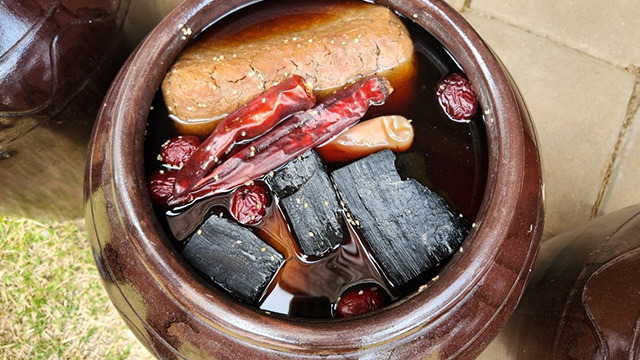
- Drop in 2–3 pieces of charcoal that have been heated and cooled — this helps eliminate harmful bacteria and neutralizes unwanted odors.
- Add 5–10 dried red chili peppers, which provide natural antibacterial properties and help keep the liquid clear and bright.
- Adding dried jujubes will enhance sweetness and add a subtle depth of flavor to the final product.
Step 5: Covering and Starting Fermentation
- Cover the top of the jar with hanji (Korean traditional paper) or a clean breathable cloth to keep out insects and debris. Avoid plastic wrap or vinyl as it blocks airflow and can negatively affect fermentation.
- Place the jar in a location with good sunlight and ventilation — a traditional jangdokdae (jar terrace) is ideal.
- Open the lid on sunny days to let the sunlight in, and always close it on rainy days and at night to prevent contamination.
- During the fermentation period, stir the contents gently about once a month to ensure even fermentation throughout.
- Allow the mixture to ferment for 40–60 days (approximately 2 months when starting in Jeongwol).
Step 6: Separating Ganjang and Doenjang (The Most Important Step!)
After 40–60 days, it is time to separate the soy sauce (ganjang) and the soybean paste (doenjang). This process is called “Jang Gareugi” (장 가르기) in Korean.
- Remove the meju blocks from the jar and separate the liquid (ganjang) from the solids (doenjang).
- Pour the liquid ganjang into a pot and bring it to a full boil to sterilize it. Skim off any foam that rises to the surface, then allow it to cool before transferring it back into a clean jar.
- Take the strained meju solids, mash them thoroughly, and mix in salt to taste — this becomes your doenjang. Adjust the saltiness so it is neither too salty nor too bland.
- Pack the doenjang tightly into a jar, pressing out any air pockets, and finish by sprinkling a layer of salt on top to seal and preserve it.
Step 7: Aging and Storage
- Ganjang (soy sauce) develops its best flavor after at least 6 months to 1 year or more of aging — the longer, the richer.
- Doenjang (soybean paste) should be aged for at least 3 months before consumption.
- Store both jars on a well-ventilated jangdokdae with partial sunlight exposure throughout the year.
- Even during storage, airing the jars out on sunny days will continue to improve the flavor and preserve quality.
⚠️ Key Tips for Success
- Meju quality is everything. Choose meju blocks with evenly distributed, healthy white mold for the best results.
- Always use natural sea salt (Cheonillyeom) and make sure the bittern (gansu) has been fully drained before use.
- Never make Jang on a rainy day. High humidity dramatically increases the risk of harmful bacterial growth.
- Traditionally, Koreans chose auspicious days on the lunar calendar — such as the Day of the Horse (午日) or the Day of the Rabbit (卯日) — to begin making Jang.
- During fermentation, skim off any white film (yeast layer) that forms on the surface, and if black mold appears, sprinkle salt directly on the affected area to neutralize it.
Making Jeongwol Jang with care and patience is said to bring good health and abundance throughout the year. Just like the flavo KoreanFermentedSoybean Flavor r of Jang slowly deepening over time, may this year be full of richness and joy for you! 🙏
"이 포스팅은 쿠팡 파트너스 활동의 일환으로, 이에 따른 일정액의 수수료를 제공받습니다."
https://link.coupang.com/a/d6Hav5
[순창메주] 정월 장담그기 완벽 풀세트(메주 6개+천일염+건고추+숯+누름독+순창샘물7L) - 기타즉석
쿠팡에서 [순창메주] 정월 장담그기 완벽 풀세트(메주 6개+천일염+건고추+숯+누름독+순창샘물7L) 구매하고 더 많은 혜택을 받으세요! 지금 할인중인 다른 기타즉석식품 제품도 바로 쿠팡에서 확
www.coupang.com